


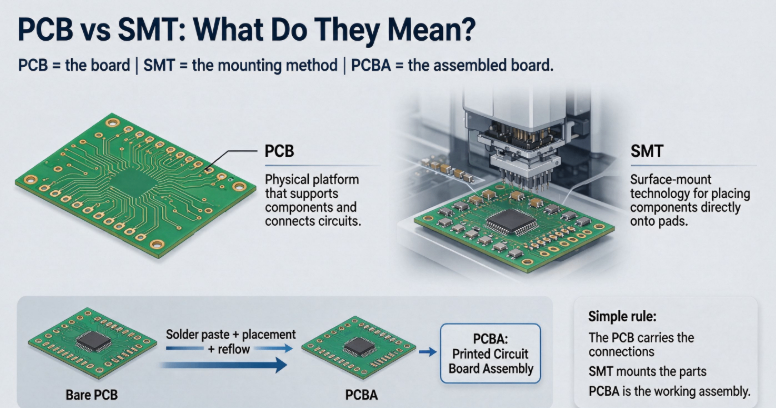
PCB and SMT are two common terms in electronics manufacturing, but they describe different things. A PCB (Printed Circuit Board) is the physical board that supports and connects electronic components. SMT (Surface Mount Technology) is a manufacturing method used to mount electronic components directly onto the board's surface.
Understanding the difference between PCB and SMT helps engineers and purchasing teams define their manufacturing requirements. It also prevents a common sourcing mistake: requesting a PCB when the project actually needs a fully assembled PCBA.
1. What Is a PCB and What Is SMT?
A PCB is the foundation of an electronic circuit. It consists of an insulating substrate with conductive copper traces, pads, and other features that connect components according to the circuit design.
A bare PCB does not normally contain all the electronic components needed to make a device work. It provides the physical structure and electrical connections for those components.
SMT, on the other hand, is a component assembly technology. Instead of inserting component leads through drilled holes, SMT places surface-mount devices (SMDs) directly onto designated pads on the PCB. Solder paste and a reflow process create the electrical and mechanical connections.
In simple terms:
PCB: The board that carries the circuit connections.
SMT: A method for mounting electronic components onto the board.
PCBA: A printed circuit board populated with electronic components through an assembly process.
A PCB can be manufactured without SMT assembly. However, SMT is one of the most widely used methods for turning a bare PCB into a functional electronic assembly.
2. PCB vs. SMT: What Are the Main Differences?
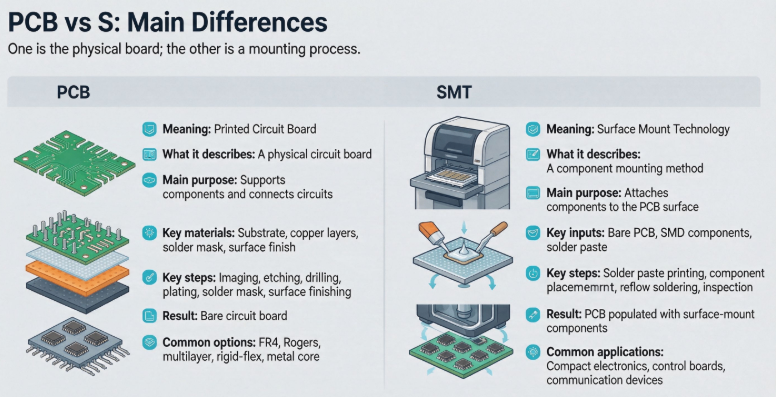
The main difference is their role in electronics manufacturing. PCB refers to the physical product, while SMT refers to the technology used during assembly.
| Comparison | PCB | SMT |
|---|---|---|
| Meaning | Printed Circuit Board | Surface Mount Technology |
| What it describes | A physical circuit board | A component mounting method |
| Main purpose | Supports components and connects circuits | Attaches electronic components to the PCB |
| Main materials or inputs | Substrate, copper layers, solder mask, surface finish | Bare PCB, SMD components, solder paste |
| Key production steps | Imaging, etching, drilling, plating, solder mask, surface finishing | Solder paste printing, component placement, reflow soldering, inspection |
| Final result | Bare circuit board | PCB populated with surface-mount components |
| Common options | FR4, Rogers, multilayer, rigid-flex, metal core | SMT assembly for different SMD packages |
These terms are not alternatives. A PCB is the platform on which SMT assembly takes place.
For example, an industrial control board may use a multilayer FR4 PCB to connect its circuits. SMT machines then mount resistors, capacitors, ICs, and other surface-mount components onto the board.
3. What Is the Difference Between PCB Manufacturing and SMT Assembly?
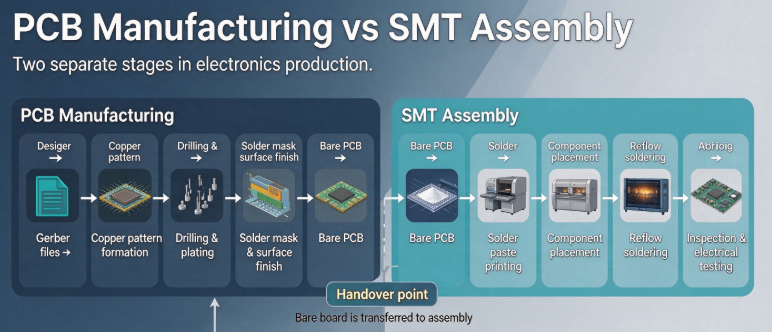
PCB manufacturing and SMT assembly are two separate stages of the electronics production process.
PCB manufacturing creates the bare board according to the design files. Depending on the project, the process may involve copper pattern formation, drilling, plating, solder mask application, surface finishing, and electrical testing.
The required PCB construction depends on the application. A simple control circuit may use a standard FR4 board, while high-frequency communication equipment may require Rogers materials. Designs with complex routing or space constraints may need multilayer, HDI, or rigid-flex PCBs.
SMT assembly starts with the manufactured board. Solder paste is printed onto the pads, components are placed by automated machines, and the board passes through a reflow oven. Inspection and electrical testing follow according to the project's requirements.
The relationship can be summarized as:
PCB design defines the circuit and board structure.
PCB fabrication produces the bare board.
Component sourcing supplies the required electronic parts.
SMT or other assembly methods mount the components.
Inspection and testing verify the finished assembly.
For buyers, the key question is whether they need only the bare boards or a complete assembled product. The answer determines which services should be included in the quotation.
4. Is SMT the Same as PCBA? What About Through-Hole Assembly?
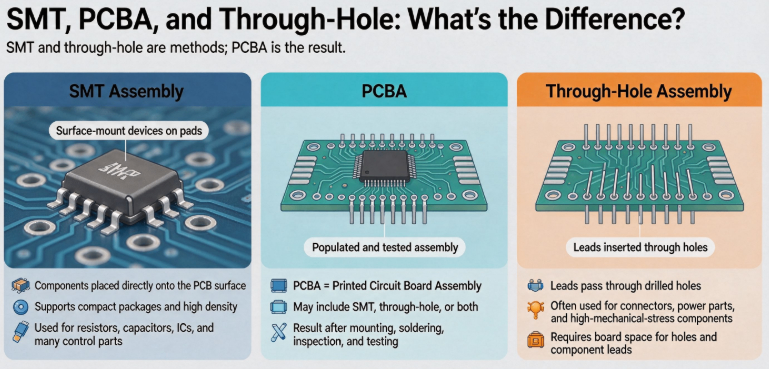
SMT and PCBA are related, but they are not the same.
PCBA stands for Printed Circuit Board Assembly. It refers to the assembled board after electronic components have been mounted and soldered. SMT is one method used to produce a PCBA.
Another common method is through-hole technology (THT). With this approach, component leads pass through holes in the PCB and are soldered to pads on the opposite side.
The two methods serve different design requirements:
| Feature | SMT Assembly | Through-Hole Assembly |
|---|---|---|
| Component mounting | Directly onto PCB surface | Leads inserted through PCB holes |
| Component size | Supports compact, small packages | Often used for larger leaded components |
| Production | Highly automated | May involve manual or automated insertion and soldering |
| Board space | Supports higher component density | Requires space for drilled holes and component leads |
| Typical applications | Compact electronics, control boards, communication devices | Connectors, power components, and parts requiring mechanical support |
Some products use both methods. For example, a board may use SMT for resistors, capacitors, and integrated circuits, while using through-hole components for connectors or parts that experience mechanical stress.
This is known as mixed-technology PCB assembly. The appropriate method depends on component specifications, board design, operating conditions, and production requirements.
5. When Should You Choose PCB Fabrication Only or SMT PCB Assembly?
The right service depends on what your production team needs to receive.
Choose PCB fabrication only when:
Your company already has an in-house assembly line.
You want to source electronic components and manage assembly separately.
You need bare boards for design verification or electrical testing.
You have an established component inventory and assembly process.
Choose SMT PCB assembly when:
You need components mounted on the bare boards.
Your project uses surface-mount components.
You want to outsource automated placement and soldering.
You need inspection and testing as part of production.
For projects that require fewer supplier handoffs, turnkey PCB assembly may be a better option. A turnkey provider coordinates PCB fabrication, component sourcing, assembly, and agreed testing services.
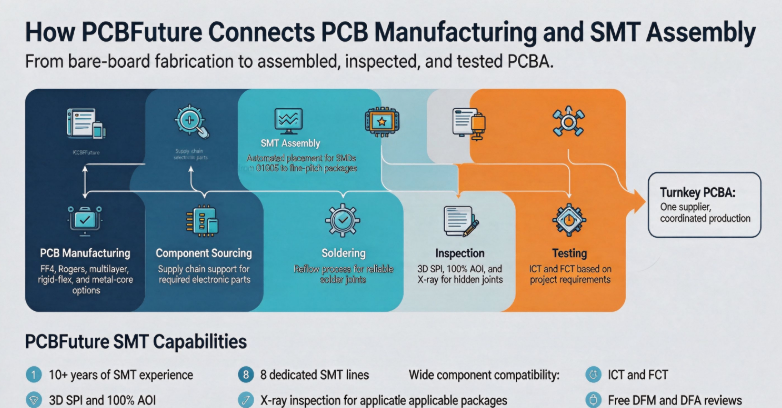
PCBFuture supports PCB manufacturing and assembly services, including FR4, Rogers, multilayer, rigid-flex, and other PCB options. Its SMT service covers the assembly process from solder paste printing and component placement to reflow soldering, inspection, and testing.
6. How Does PCBFuture Connect PCB Manufacturing with SMT Assembly?
For electronics buyers, coordinating separate PCB fabrication and assembly suppliers can create extra work. Differences in file versions, material specifications, component availability, and delivery schedules may affect the production plan.
PCBFuture offers PCB fabrication, SMT PCB assembly, and turnkey PCB assembly services to support different project requirements.
Its SMT assembly capabilities include:
10+ years of SMT experience: Supporting electronics projects from prototypes to production.
8 dedicated SMT lines: For automated surface-mount assembly.
Wide component compatibility: From 01005 components to fine-pitch packages, including BGA, QFN, and QFP.
Process inspection: 3D solder paste inspection (SPI) and 100% AOI inspection.
X-ray inspection: For checking hidden solder joints in applicable packages such as BGA and QFN.
Electrical testing: ICT and FCT based on project requirements.
One-stop manufacturing: PCB fabrication, component sourcing, assembly, and related services.
PCBFuture also provides free DFM and DFA reviews to help identify potential manufacturing issues before production. Customers can request prototype, low-volume, or mass-production support depending on their project needs.
7. What Information Should You Provide When Requesting a PCB or SMT Quote?
A clear quotation request helps the manufacturer understand whether you need bare PCB fabrication, SMT assembly, or a complete PCBA solution.
For PCB fabrication, prepare:
Gerber files
PCB dimensions and layer count
Board material and thickness
Copper weight
Surface finish
Required quantity
For SMT assembly, also provide:
Bill of Materials (BOM)
Pick-and-place files
Assembly drawings
Component sourcing requirements
Testing and inspection requirements
If you are not sure which service your project requires, send the design files and explain whether you need bare boards or assembled boards. The engineering team can review the requirements and recommend a suitable manufacturing route.
Conclusion: PCB Is the Board, While SMT Is the Assembly Technology
The difference between PCB and SMT is straightforward: a PCB is the physical circuit board, while SMT is a technology for mounting electronic components onto its surface. PCB fabrication creates the bare board, and SMT assembly helps turn it into a populated electronic assembly.
For buyers planning a new electronics project, understanding this distinction makes it easier to define the scope of work and compare supplier quotations. Whether you need bare PCBs, SMT assembly, or a turnkey PCBA solution, PCBFuture can support your project from board manufacturing to assembly and testing.
Contact PCBFuture with your Gerber files, BOM, and production requirements to discuss your PCB manufacturing or SMT PCB assembly project.


